'Inglorious Empire: What the British did to India' - Shashi Tharoor
13 July 2026 · Rob
I play a lot of games. From the colourful stories of Amerithrash to the number-crunching of Euro’s, from mind expanding RPGs to the solitaire entertainment of computergames, chances are I have meddled with them. Back when I was a tad younger, I started in this hobby with classic Avalon Hill hex-n-counter wargames and, though I really love all types of games, wargames remain my favourite. To me, these historical games are not just a really nice way to pass the time on a dreary Sunday afternoon, they actually teach me about subjects I had little or no prior knowledge of. The games themselves do this – like, when I first played (the old Victory Games’ version of) ‘Vietnam: 1965-1975’ I understood better the frustration of the Americans in this complicated conflict, the politics and logistics. When playing 'Panzer', I started to actually, really understand how the Red Army had to deal with the Panther tanks – and had to learn to adapt my tactics to start winning scenarios. Our beloved pastime is more than just that: these games trigger interest, ask questions and in doing so educate.
So, when I am not playing a game, I read. I really enjoy finding books that enhance my understanding of the background of a game. Now, not a month ago I got ‘John Company’, which if you don’t know, is a game that deals with the exploits (quite literally as I would find out) of the British East India Company. Having picked the game up based on various reviews, once I did get it in my hands I realised I had no real clue what had happened in India under the British Empire. So, I went online to find good books on the subject.
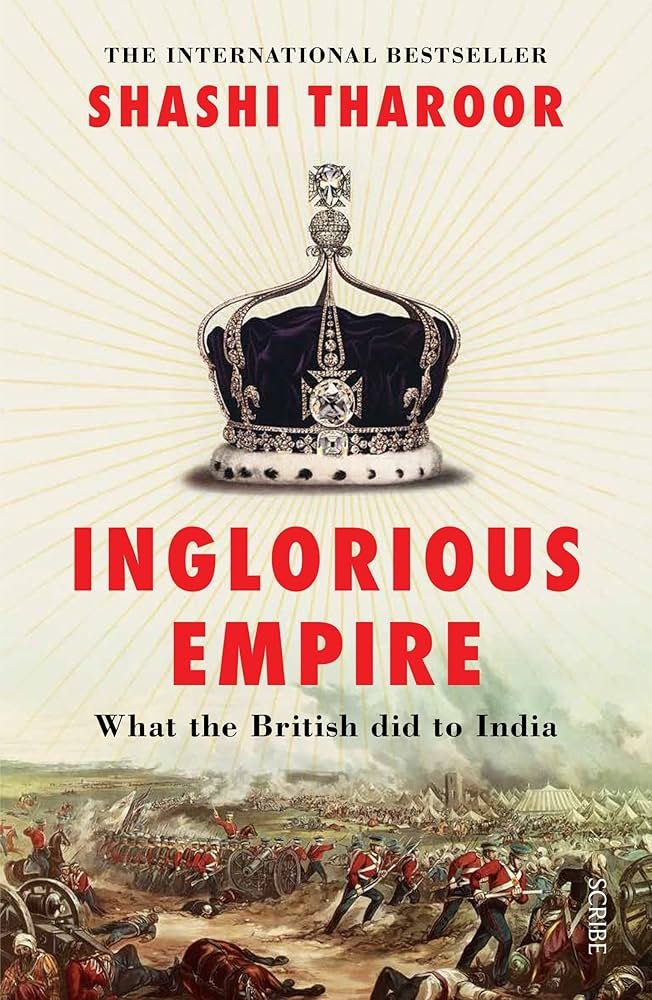 So, I bought ‘Inglorious Empire’ by Shashi Tharoor. This is a 300 plus pages book on how India and the Indians fared under the reign of the British and the effects of the EIC (East India Company) on this nation, effects tangible to this day. Mr. Tharoor in essence takes all modern-day apologist arguments about why the influence of the British Empire on India has had a net positive effect and then takes them apart one at a time. Like for instance giving the Indians our Western, enlightened concepts of democracy, free press, the rule of law and then some – arguments still used to diminish the negative effects of the colonial rule over the Raj. Those arguments, he argues, are mostly false.
He demonstrates the methods used by the British to divide the Indian population and how their instrumental policy of setting various minorities up against one another has a profound effect on modern day India and Pakistan. It demonstrates that India was the third economy in the world (23% of the world’s trade was Indian and not 3% in 1948) before the EIC interfered, and how the EIC purposefully dismantled the cloth industry there only to build it back home - then sell the inferior products from England in India at high prices. All in all it is a very disturbing insight in not just how the EIC and British colonialism set India back a long way, but also how our Western views on ‘the white man’s burden’ are patently false. Mr. Tharoor does this in a very readable manner, slowly but with a certain unavoidability working towards his goals, based on solid research and evidence. When he uses an anecdote, it is almost always a British anecdote (and more often than not, of the time period) which supports the evidence. The book at it’s core is an account of what happens when unbridled capitalism is not moderated by any form of morals – even when you take the different mores of the times into account.
Reading books like this, in combination with playing the games that are influenced by those books – or vice versa – shows that our hobby is more than just pushing cardboard around: it is an enticement to learn more about the world’s history and thus, even if you do not intend to ever play a game that is even remotely connected to the colonial ills, this book I highly recommend.
Comments



Log in to reply.