Pax Britannica - how did a classic game hold up?
3 November 2026 · Rob
Sunday november 1st we came together in Amsterdam with a full complement of seven players to divide the world among the superpowers of the late 19th century in Victory Games' Pax Britannica which, as you might surmise, isn't an easy proposition. Pax Britannica (PB after this) takes at least 8 hours to play and usually more as quite few game phases can take a long time, like the negotiations and the move phase where everyone simultaneously can react to what others are doing. So, I was more than happy to have found six other fanatics to join me in a game I had not played for some 20-odd years and was also a litle apprehensive: how would such an old game with a theme that modern day gamers and designers (PB deals with colonialism) stay clear of be rated? There are some old design choices that modern gamers tend to dislike - like a convoluted administration prone to mistakes where you calculate both yout income and victory points. Not to mention my own pet-peeve: the triangular playng pieces are a (nasty expletive deleted) to pick up, stack and organise.
(Sorry about the lights reflected in the plexiglass on all following pictures.)
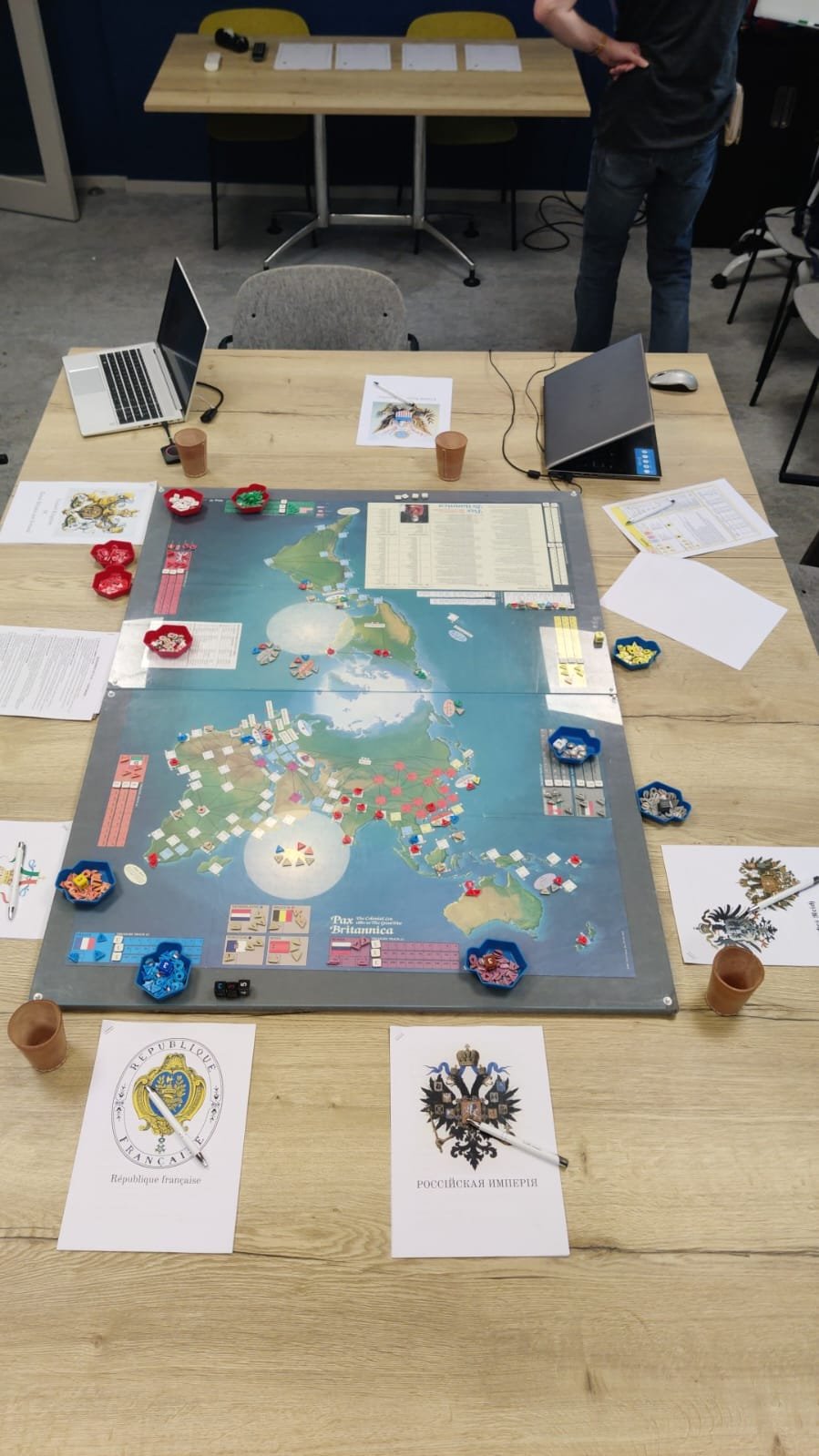
* Starting situation - yes, we have are two laptops there!*
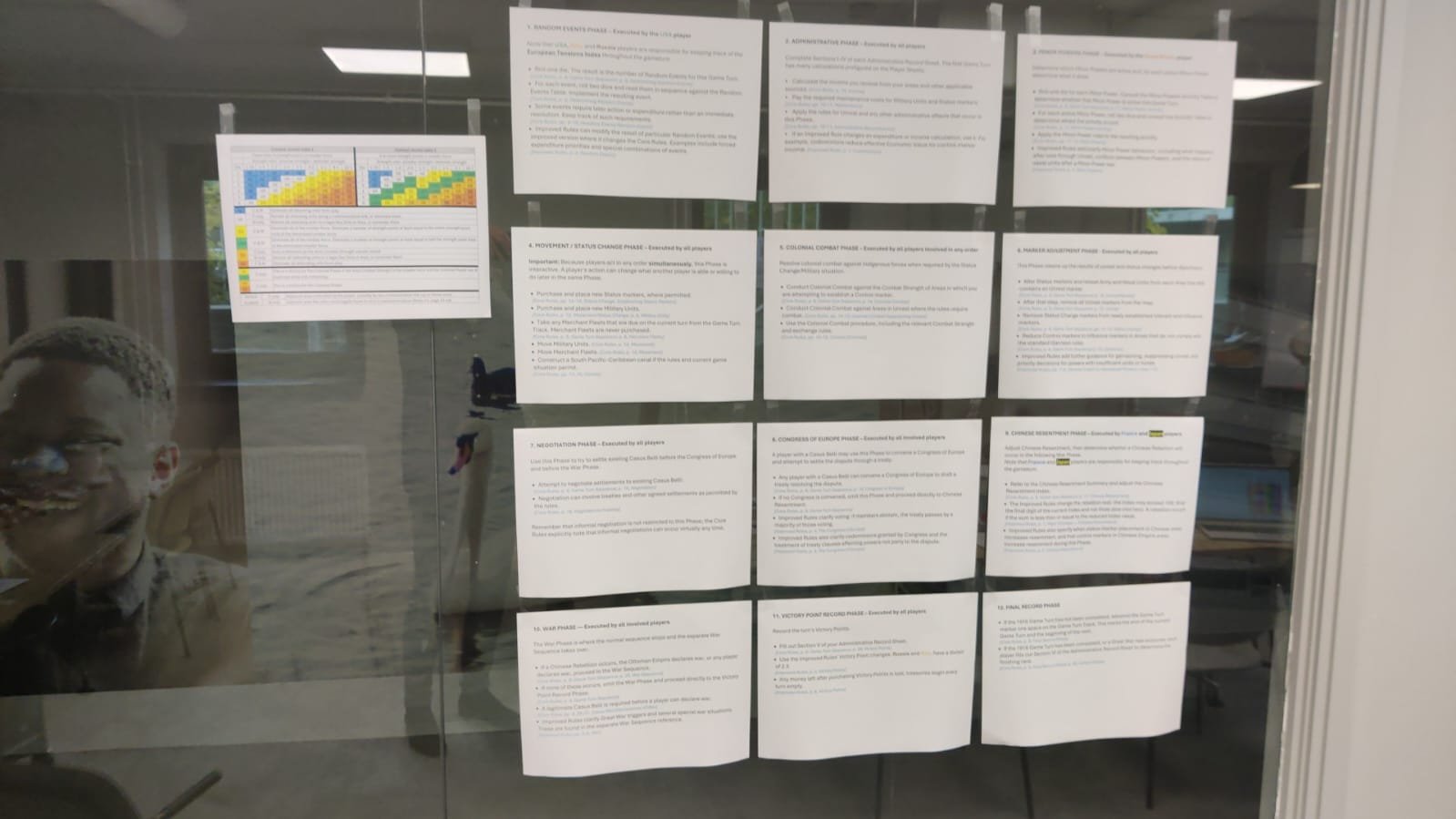
* Game turn & phases and the CRT on the walls *
So, we started at 10:00 hrs with the 1880 turn and this - as is common - meant a enormous whirlwind of activities, both on the map as the Great Powers were scrambling for the most economically and strategically valuable pieces of real estate and also in the side rooms for frantic negotiations about who would support which moves and such. Rather predictable Great Britain and France divvied up Africa with Italy attempting to gain some North African territories. While Germany and Japan were interested in the coastal areas in Asia and islands in Oceania, the USA focussed on the America's and kept reminding everybody about their (unilaterally decided so us Olde Worlders were not too impressed with these upstart transatlantic cousins) Monroe Doctrine. The first tensions were found in the Raj as the Tsar increased his interests in Afghanistan, to which the British immediately objected and drew a line in the sand, warning Moscow not to interfere in the Indian subcontinent and stay clear, promising the Tsar a non interference treaty in Persia if the Russians would stay clear of India. The Tsar did not agree, offering no clues about his motives which further antagonised the British evoys.
As 1884 rolled into view, the positions were consolidated where possible though there were German and Italian interests popping up in South America, much to the concern of Washington who was spending a lot of time and efforts preparing a canal in Panama.
However, the true conflict continued in Afghanistan as local unrest was used by the Russians as a pretext to turn the area into a protectorate. The British vehemently protested, citing their earlier warning and also wanting to hear a good enough reason why the Russians were investing so heavily in an economic backwater which could bring nothing but trouble (the natives were quite quarrelsome) and also sending a massive army there. Moscow could in no form or shape give a reason (more on this would later become aparrent) and so Britain saw no option than to demand a conference which was held in Kyoto. All great powers besides the USA (too busy with their doctrine most likely) attended. Several proposals were made to prevent a full scale war that potentially would turn into a Great War (as Germany and France had a defensive alliance with Russia) of which none could find agreement. In the end, Italy brokered a deal between Great Britain and Russia that did find (though with some protesting and grumbling by Britain) agreement and thus, as civilised nations ought to, peace was preserved.
As the years passed, most powers consolidated their holdings though there was some tension in Southern America as Germany and France and to a small extend, Italy, started to encroach on American holdings.
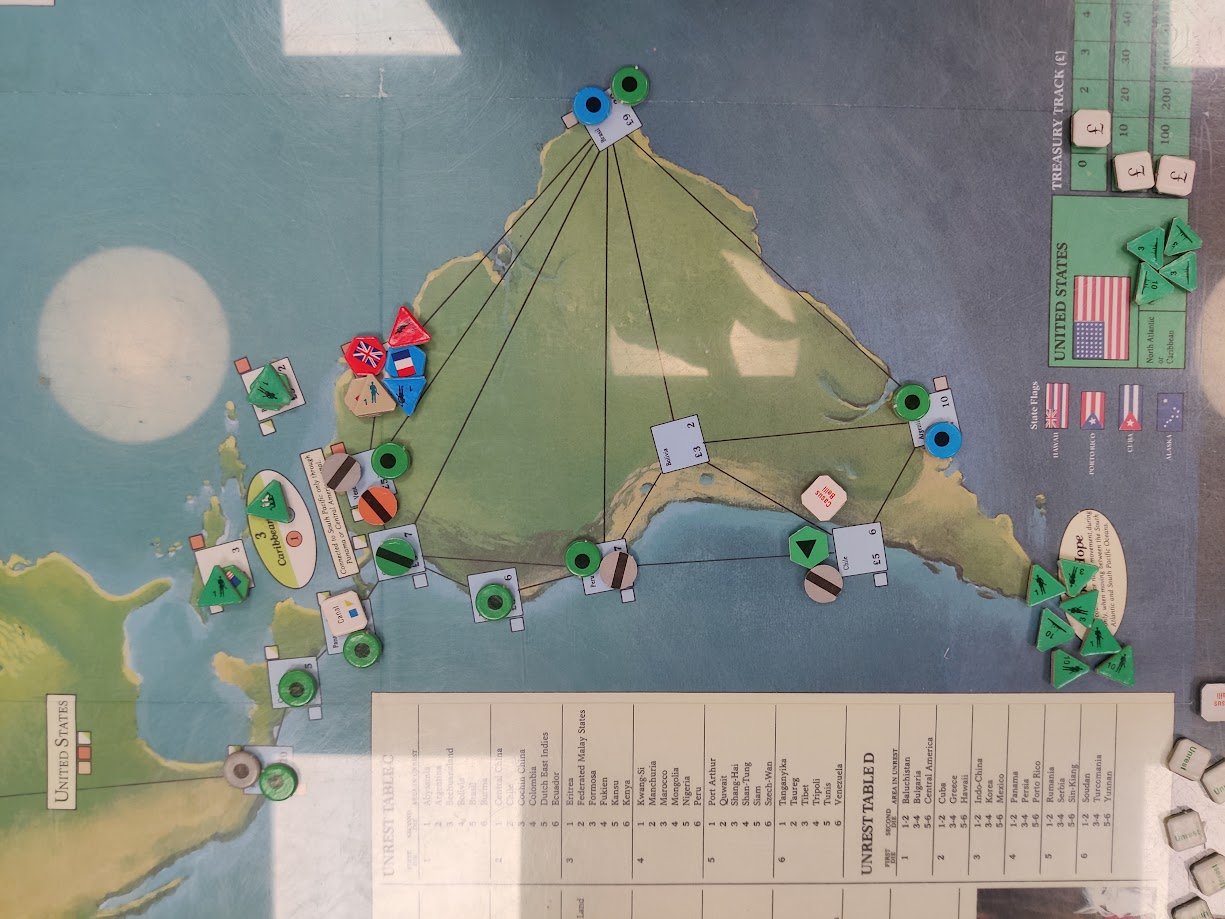
* Green the USA, grey Germany, blue France and Orange Italy *
The Americans found cause for war in Chile and even sent a lange army as a precaution as Germany and France were also mobilising their forces, but, cooler heads prevailed and again, war was averted.
In Africa, all was rather calm as previous agreements beteen France and Great Britain saw the continent neatly divided between the two Great Powers.
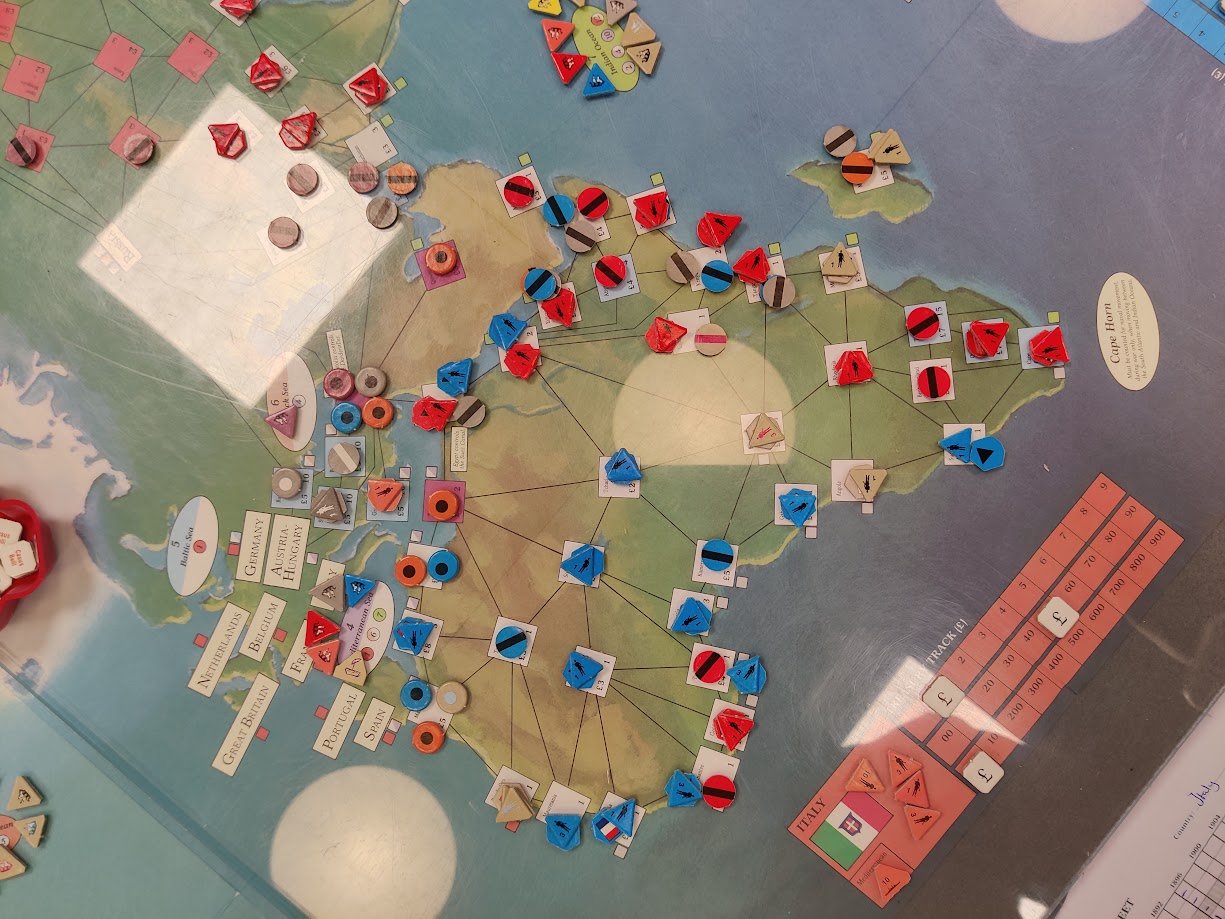
Around 1896 there was a diplomatic incident where the new concept of Yellow Journalism caused a sentiment in both Spain and the USA that Washington used as a casus belli. Obviously, the Spanish forces were no match for the USA's military and Spain lost all their holdings in the Western hemisphere as well as the Phillipines. A second incident saw the USA again taking up arms against Spain, this time annexing the Rio d'Oro territories in western Africa.
On the other end of the globe, all was rather quiet in Asia.
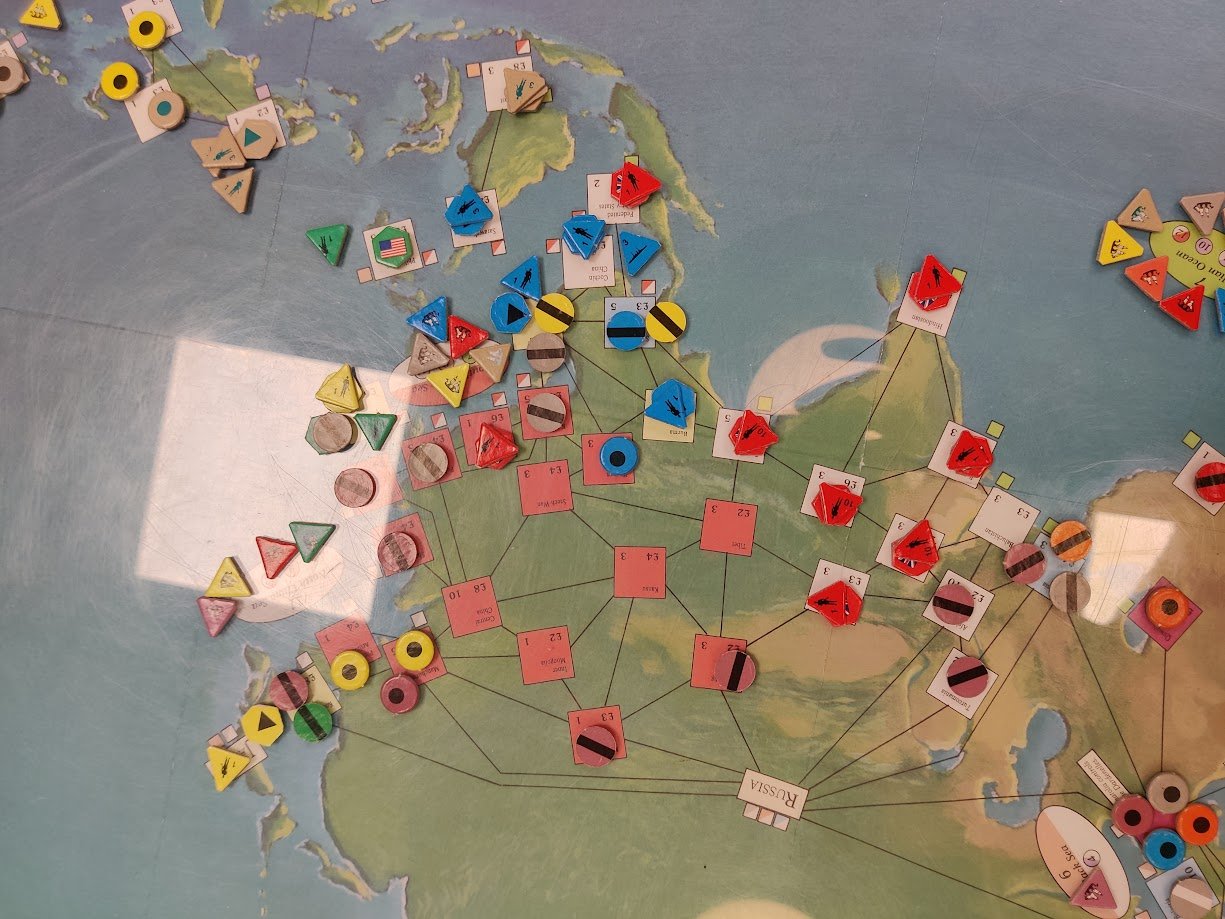
Though the Great Powers had some interests in China and Indochina, it was from the start a quiet and calm theatre where the dowager Empress Cixi had little interference of the foreigners and could remain independent. The threat of Japan's power never materialised.
Around 1904 it became (painfully, to some) clear that the Tsar had been the smartest one of the seven, as Russia had invested greatly in their own development and industry, not meddling too much outside their borders except the ill-fated expedition into Afghanistan - an expedition that, as British spies would uncover years later, was paid for and instigated by the French(!). As the other powers were spending too much money and means to keep their costly empires abroad while neglecting their internal economy, the Russian Empire made great advancements in this area and, as it would turn out, had progressed far ahead of any other power.
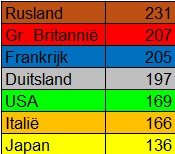
Now, a big caveat - this score was based on the situation on the board after seven turns when it became obvious that nobody would be able to overtake Russia in the remaining three turns and includes possible bonuspoints that were very likely to be gained by the various powers but by no means certain. This does not mean that the situation for the other six powers is unalterable. It is quite possible that France or Germany would have overtaken Great Britain and the USA and Italy too could argue about the fifth place.
In the end, we found that we had an entertaining day (we played seven turns in some 9 hours excluding lunches and dinner) but that the administrative part does show its age. It is a hassle, even though we did use an Excel spreadsheet to keep track and had a few facilitating forms to speed this part up. What does speaks for the game design is that the game engine works and works well, and it is still quite innovative even though it is 40 years old and most likely a newer version would use more modern, streamlined concepts - PB does hold it's own even now. It is a great game in empire building and diplomacy where war is a threat but never a goal. Even with five new players, it was perfectly doable but, as with all BIG games, it's an investment.
I would like to congratulate Tsar Menno with his clever understanding of the system and using that to great succes. And of course, all players to indulge an Olde Pharte like me in playing this relic.
Finally, I would like to point out the the original designer, Greg Costikyan, was a great fan of the Victorian area which shows in his multiple love declarations throughout the rules, culminating in several rather antiquated poems by Rudyard Kipling extolling the greatness of the colonisers and their lording over the natives. Therefore as a counterweight and to make damn sure we the players know better than to think colonialism and Western paternalism are great ideas that should be reinstated like mister Costikyan is fond of hinting at, I will end with 'The Brown Man's Burden' - a satirical poem written by British politician and journalist Henry Labouchère in 1899 in respons the Kipling's 'The White Man's Burden'. It contains strong racist words which should be seen as they are intended - a sarcastic, satirical respons to Kipling's poem and the rampant colonialism of that era.
Pile on the brown man’s burden
To gratify your greed;
Go, clear away the “niggers”
Who progress would impede;
Be very stern, for truly
‘Tis useless to be mild
With new-caught, sullen peoples,
Half devil and half child.
Pile on the brown man’s burden;
And, if ye rouse his hate,
Meet his old-fashioned reasons
With Maxims up to date.
With shells and dumdum bullets
A hundred times made plain
The brown man’s loss must ever
Imply the white man’s gain.
Pile on the brown man’s burden,
compel him to be free;
Let all your manifestoes
Reek with philanthropy.
And if with heathen folly
He dares your will dispute,
Then, in the name of freedom,
Don’t hesitate to shoot.
Pile on the brown man’s burden,
And if his cry be sore,
That surely need not irk you–
Ye’ve driven slaves before.
Seize on his ports and pastures,
The fields his people tread;
Go make from them your living,
And mark them with his dead.
Pile on the brown man’s burden,
And through the world proclaim
That ye are Freedom’s agent–
There’s no more paying game!
And, should your own past history
Straight in your teeth be thrown,
Retort that independence
Is good for whites alone.
Comments



And I agree with you that, although I had a splendid time, the game mechanics are too laborious and didn't age well.
Log in to reply.