September meetup
20 September 2026 · Nick
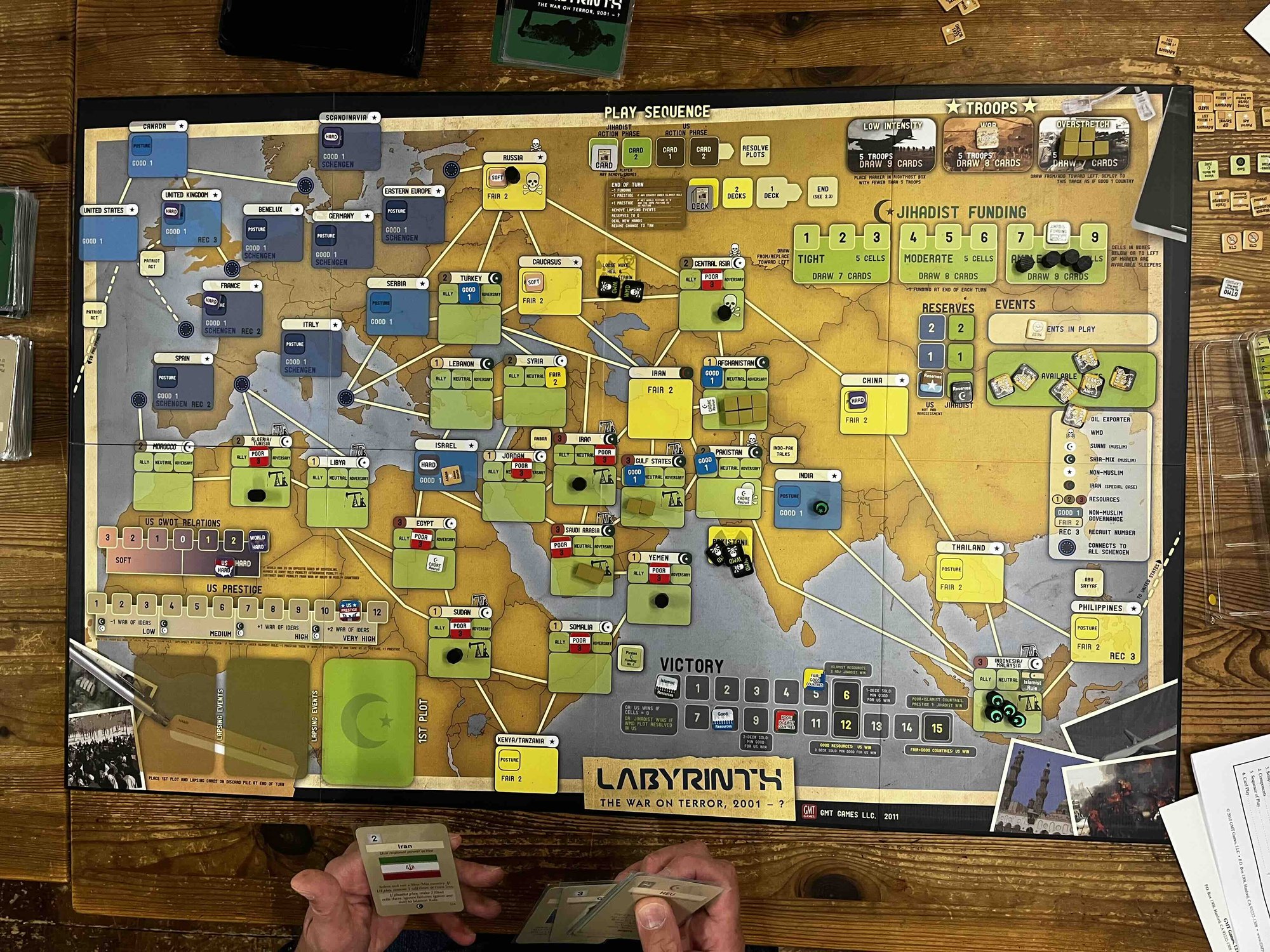 This meetup, Martin and Menno played Labyrinth as shown on the right side. I actually have no idea how it went as I was busy as an umpire running a kriegsspiel, with Vasiliy and Thomas as opposing parties.
In this kriegsspiel (using the Battle decisions rules by Catastrophe games), the battle of Breitenfeld (1631) was recreated, be it in a failry abstract way. In the original battle, during the 30-year war near Leipzig, the Swedish king routed a army of the Holy Roman Empire (HRE).
Adter receiving initail instructions, Thomas and Vasily were each given scenario instructions, their startling locations on the map and an approximate location of their enemy. For both of them, the goal was the same: close with the enemy and defeat him. The armies were quite similar except the Habsburger had two more cavalry regiments (in total twice the number of the Swedish cavalry).
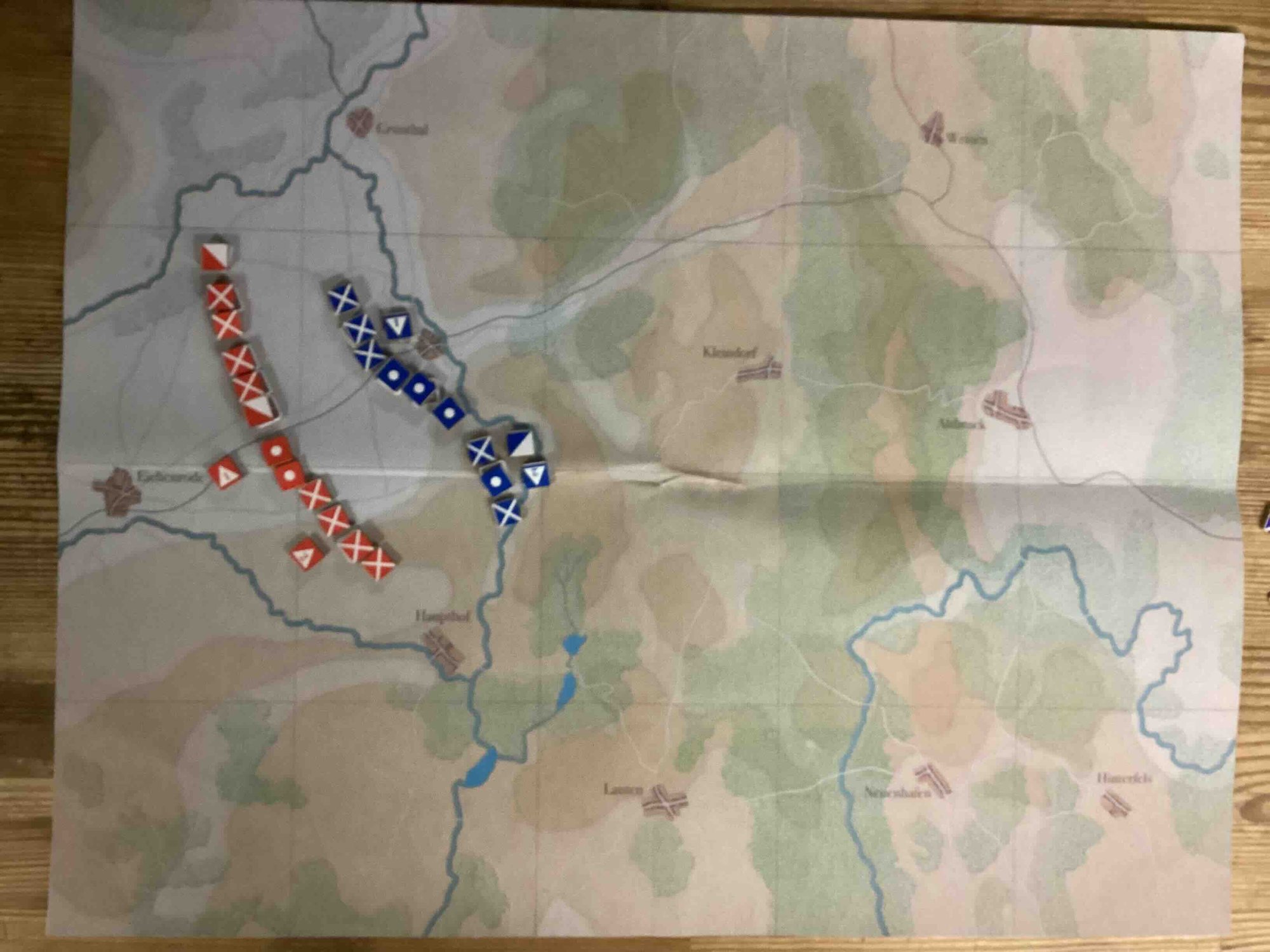
Thomas and Vasily both had their own map and playing pieces and could not see their oppnents map, and certainly not the master map that the umpire used. Each turn they gave written orders to their troops that the umpire tried to execute as well as possible. At the start of the first turn, both armies could not see each other as they were hidden by hills. By the end of the first turn, both armies had arrived at the central plain (ringed by mountains) and could see an approximate outline of their opponent although distances were too large to identify units. Shown in this write-up is only the master map.
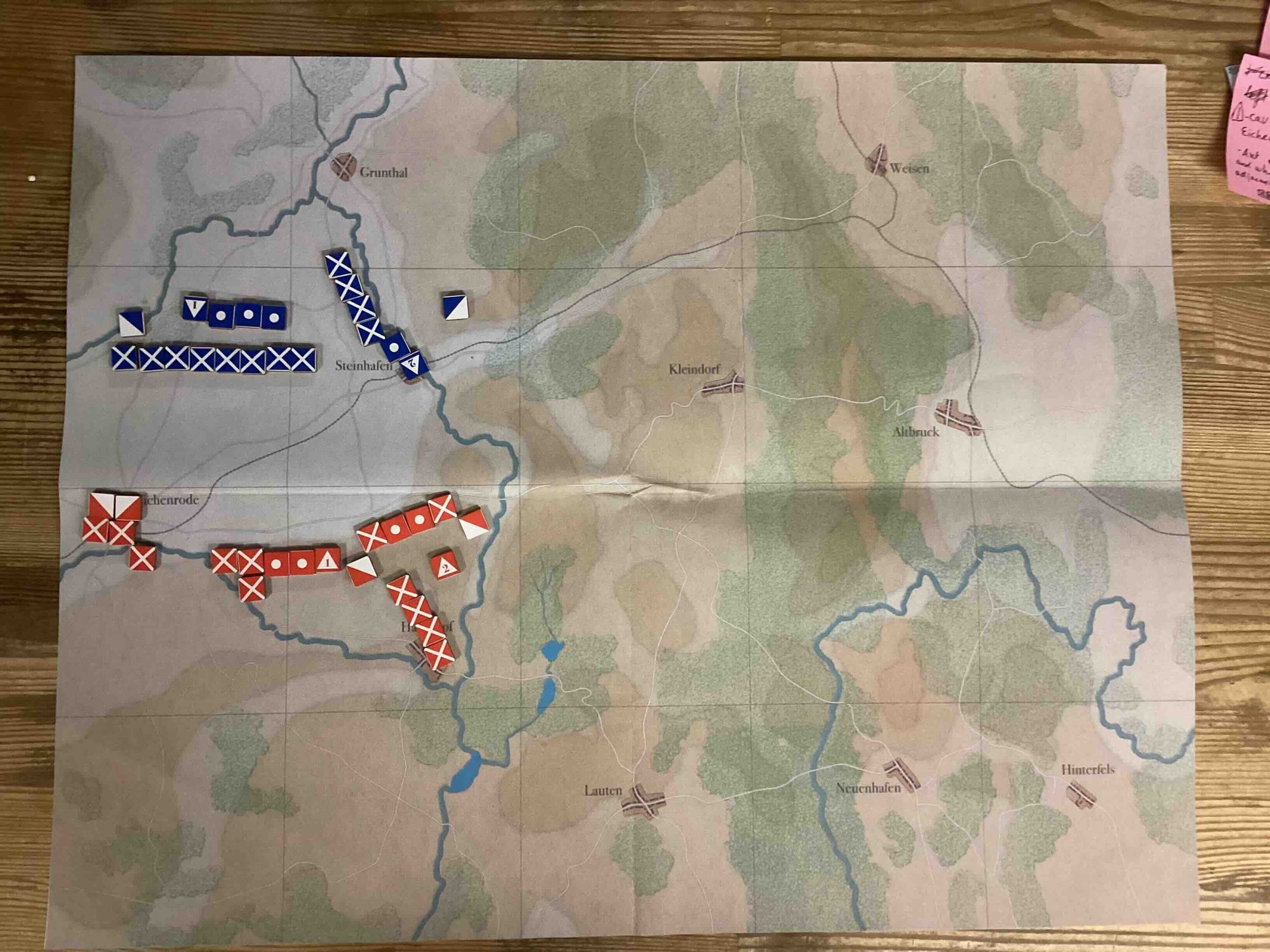
Both armies consisted of infantry (diagonal crosses), cavalry (white/colored triangles), artillery (dots) and leaders (numbered whote triangle). The swedish (blue, Vasiliy) had a cavalry unit high atop a hill, as a lookout, north east of Steinhafen (imaginary town). The HRE (red, Thomas) was arrayed on a hill slope to the south. The HRE troops in the village of Eichenrode (west flank of HRE) were actually invisible to the Swedish, and neither side could identify unit type at the current distances.
The Swedish went on the attack, with three infantry regiments and a cavalry regiment attacking Eichenrode, while his 2nd command (column near Steinhafen) crossed the river and bent off east and the southwards into the hills.
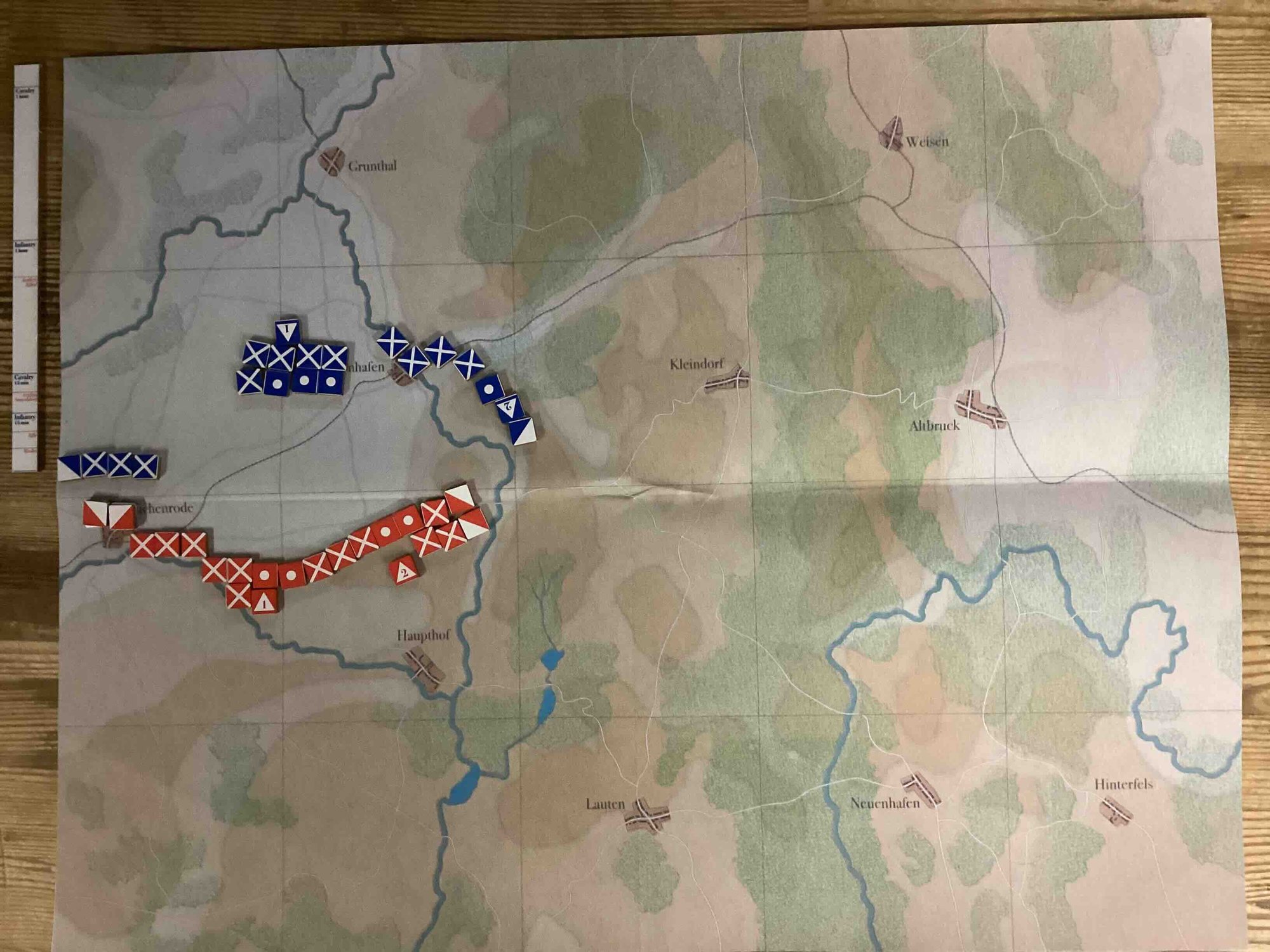
Initially the attack on Eichenrode went quite well (HRE's cavalry could not exchange fires, only melee) but Thomas managed to sneak in more infantry which eventually pushed back the Swedes. On the east side, the swedish army first moved over the hills and then off into a valley to the east that hid them from view from the HRE. While Thomas repositioned two infrantry regiments to guard the river crossing there, they were no match to the combined fire power of four infantry regiments and an artillery unit that suddeny appeared over the hill. Soon, the Swedish army started to cross the river and started hitting the HRE's east flank. At the same time the bulk of Red's nr 1 command made a frontal assault on the right centre of the HRE line. Thomas (HRE) however could pivot some artittely and infantry on his west flank, to hit the Swedish line in its own flank with devastating results. The consequence was a turning fight in which both sides were able to roll up their opponents right flank.
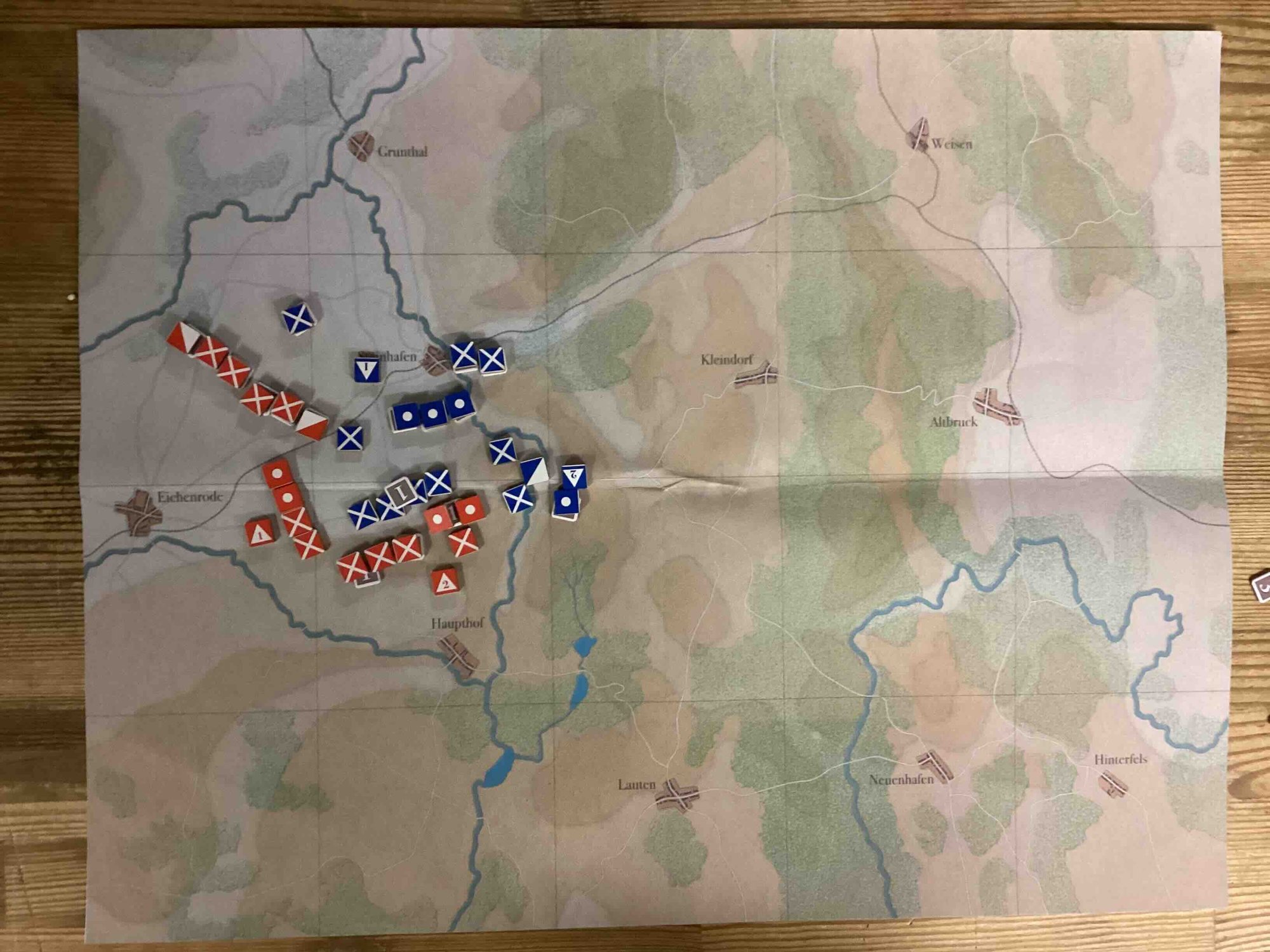 By this time, both sides were quite bloodied. Note the blue two infantry regiments just east of Steinhafen? They belong to Vasiliy's nr 2 command. He send them back to the village and as a consequence Thomas temporarily lost sight of them. When they appeared again on the west side of Steinhafen the HRE commander was not pleased :).
We stopped the game after one more turn, when battle lines had consolidated. We had played 7 out of 8 turns and the situation was fairly even.
 This battle was played out on a relatively small part of the map. Consequently commanders had a fairly decent view of their opponents army lines soon enough (but not always on unit type) although from time to time, players lost sight of part of the enemy forces. The lack of information and control created tension for both players although Vasiliy enjoyed it more than Thomas. Thomas felt the turns lasted quite long and he had little to do: writing orders takes little time but then the umpire has to prosecute them (in the end, maybe 15 min per turn). With no opponent with whom to talk (they were sitting at different tables) Thomas missed the social interaction and suggested that larger teams might be a better setup for a Kriegsspiel.
For my part, it was a good learning experience. Although I tried to prepare myself as umpire, there were so many things that suddenly needed resolving. The Kriegsspiel rules are quite open and vague. There is no prescribed turn sequence, there are no hexes to precisely maneuvre units and no clear rules for resolving combat. This was frustrating to the players (although actually that sort of fog-of-war is exactly the point of a Kriegsspiel) but it was also taxing this umpire :) That said, I learned how to provide better information to the players and organise the resolution phase better for the next game. By the way, it was really interesting to see how both Vasiliy and Thomas felt a bit helpless since they did not exactly understand the rules of the games (this is intentional). We are all very accustomed to studying rules and then trying to optimise their use during play. But this is of course not the problem real commanders faced on the battle field.
I plan to run more Kriegsspiel in the future. I will also consider how to do this online. Possibly this game lends itself more to a one-turn-per-day PBEM setup that removes downtime for the players. Although I am also certain I will be able to speed up my own umpire work as I get more experience.
Comments


Log in to reply.